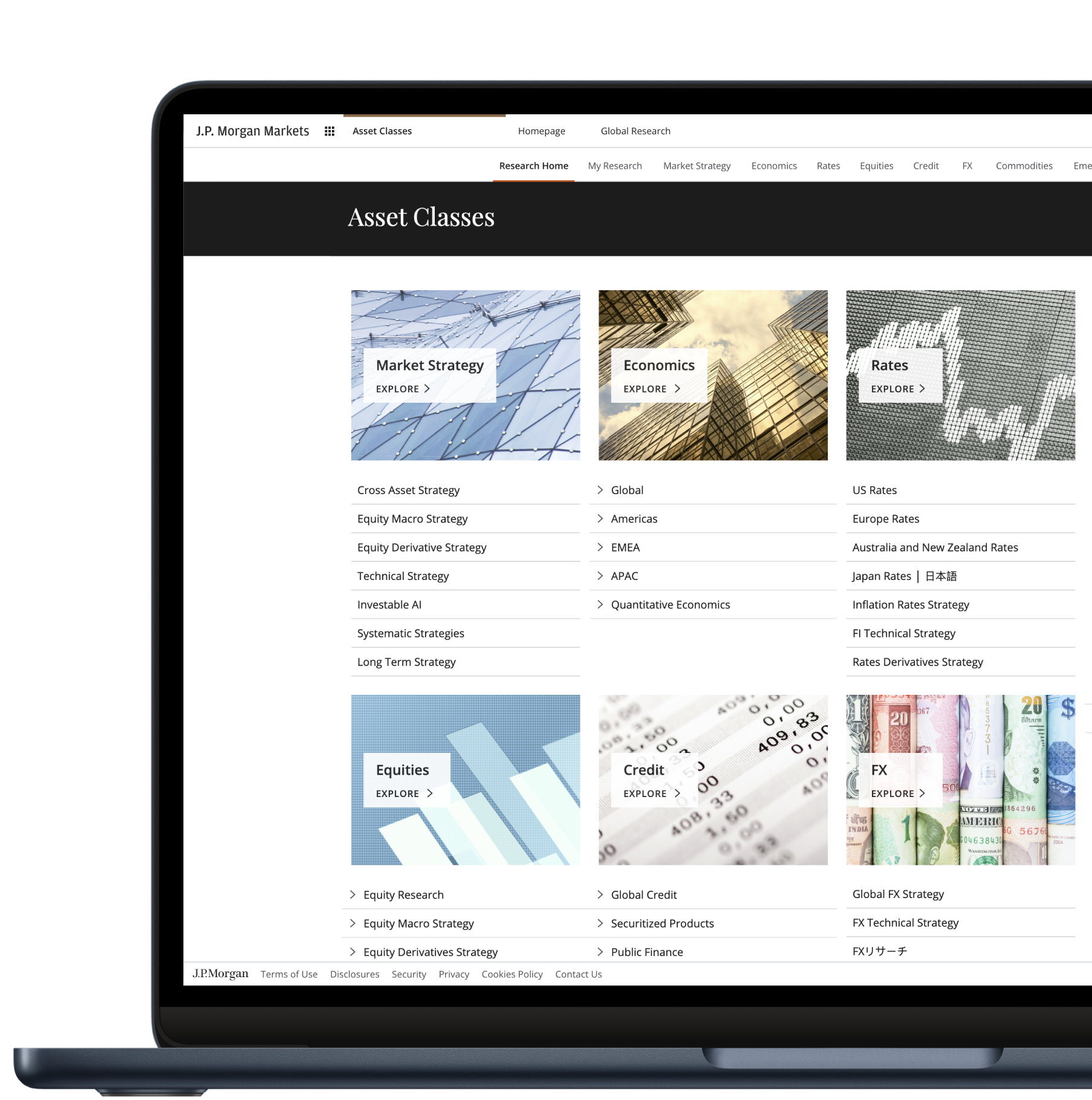
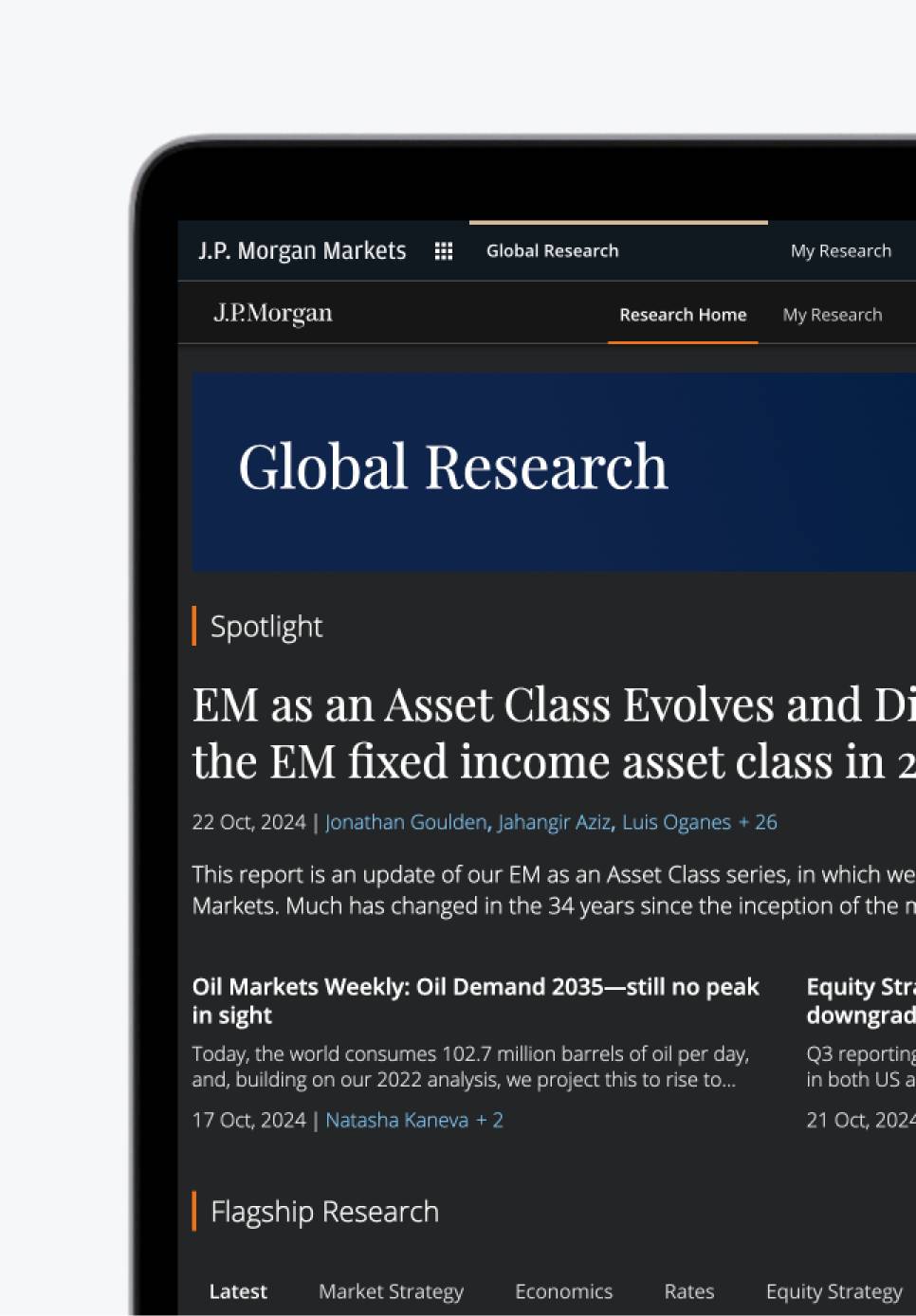
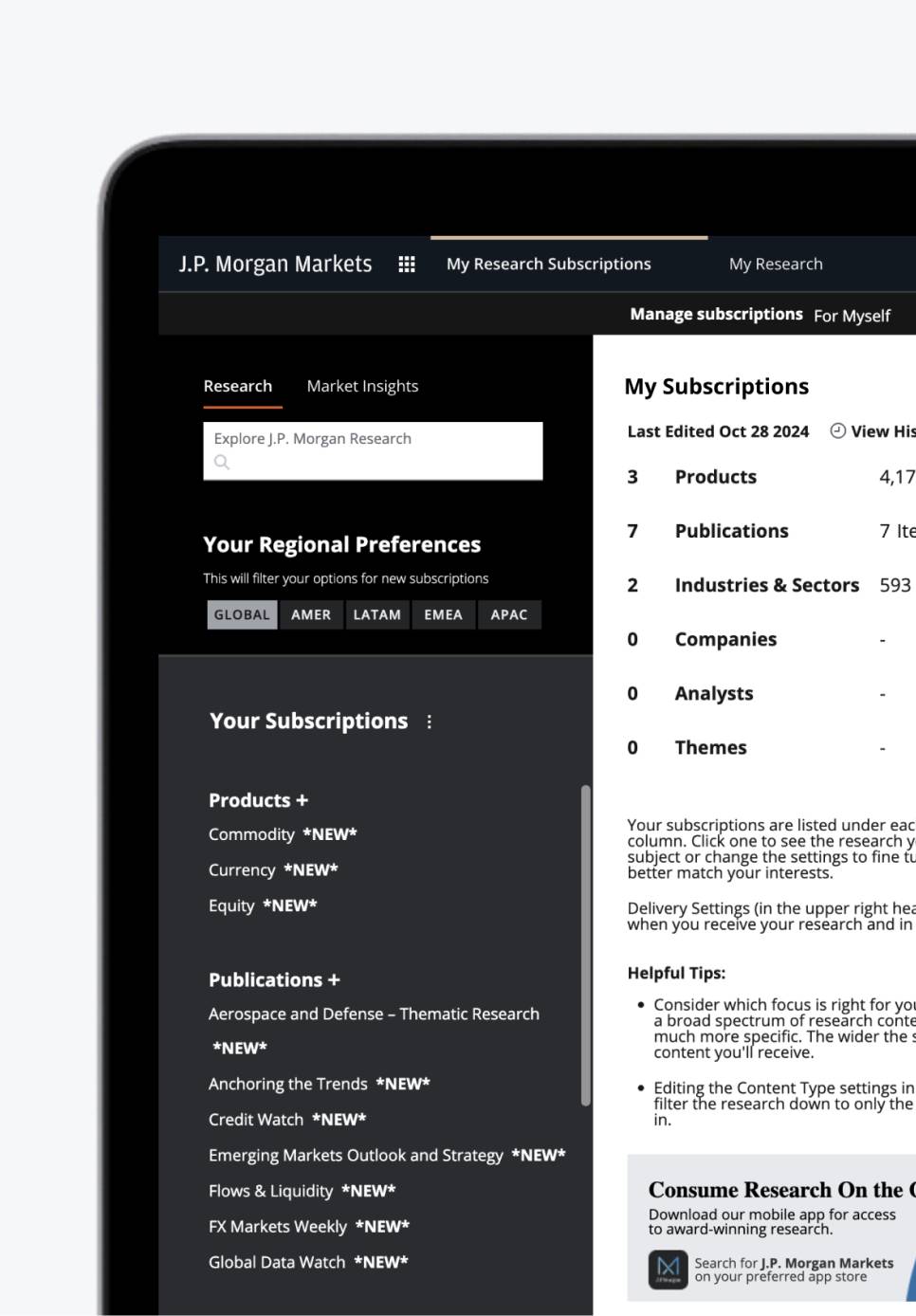
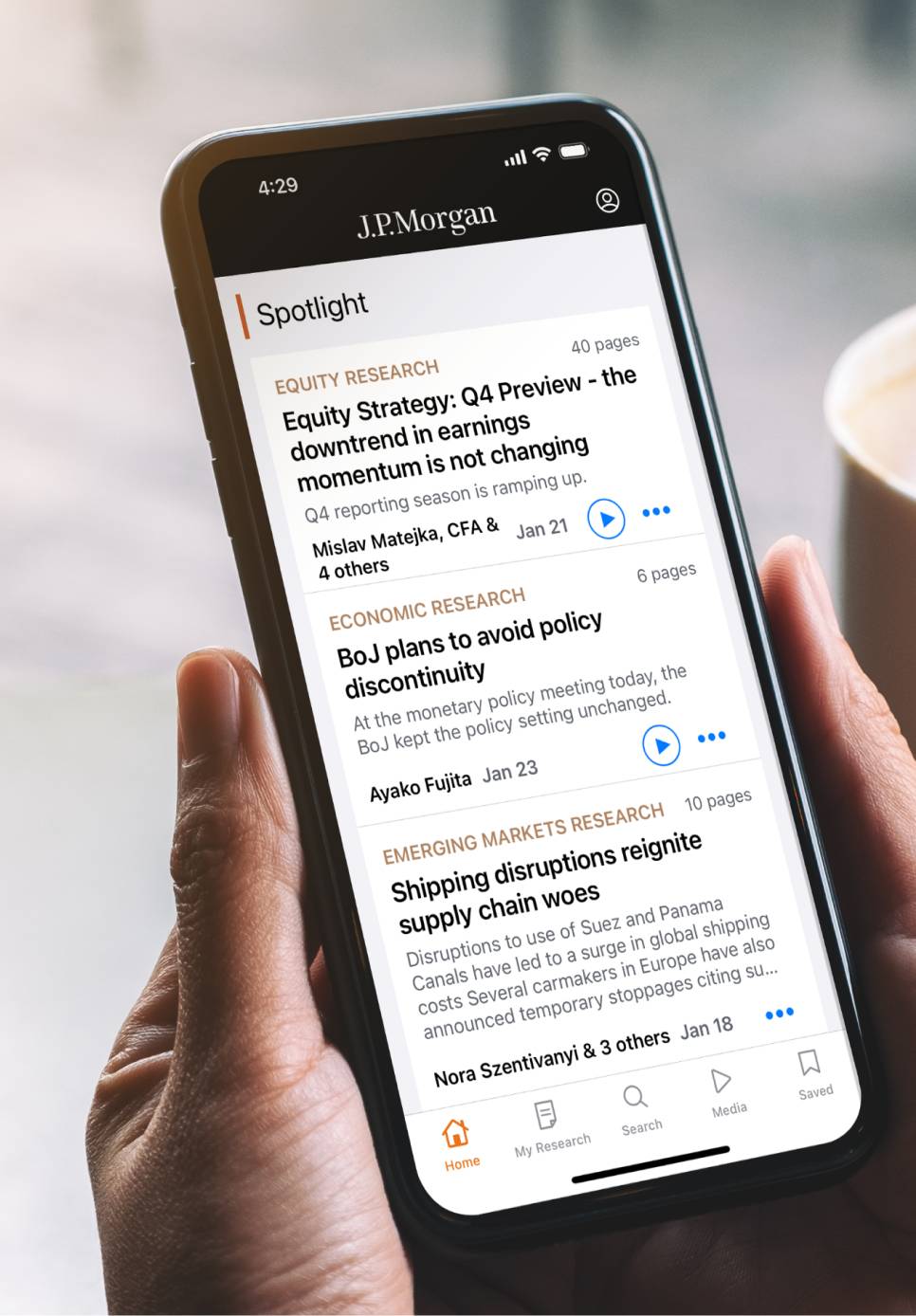
~870
Analysts located in 25 countries.
~75
Number of countries covered.
5,200+
Companies covered.
80k+
Pieces of Research published per year.
Global Research Capabilities
Complexity made clear.
Instantly unlock insights from over ten years of award-winning research spanning 5,000+ companies across 80+ countries. Get context-aware summaries that deliver the most relevant answers to your questions.
Leaders across J.P. Morgan share their views on the events that are shaping companies, industries and markets around the world.
Blockchain breakthroughs: “You can’t innovate from afar”
[Music]
Sandy Kaul: You can't innovate from afar, you have to be able to innovate from within a system. And that's why I think it's so important that we are at this pivot point where we are starting to see players who really understand the regulations, looking at these new spaces and really putting some of the best minds in the industry toward how do we make this work in a way that could really open up this opportunity in a safe way that focuses with consumer protections and still allows for innovation.
Kate Finlayson: Hello and welcome to JPMorgan's Making Sense. I'm Kate Finlayson from the FICC Market Structure and Liquidity Strategy team. With the evolution of trading technology and the look at how regulatory frameworks need to be adapted to accommodate and move with this technological change, the use of blockchain and the tokenization of assets has become far more tangible for institutional investors. In today's episode, we'll be discussing the advancements made in the use of blockchain technology, just how much has changed, what is being done by industry participants that is actually credible, and what investors should be thinking about and preparing for at this stage in the market structure shift. To discuss these dynamics, I'm thrilled to have with me Sandy Kaul, Executive Vice President and Head of innovation at Franklin Templeton, and Scott Lucas, Head of Markets Digital Assets at JPMorgan. In addition to their day jobs leading the strategy and advancement of execution on the blockchain at their firms, Sandy and Scott were appointed by the CFTC as co-chairs of the CFTC's Digital Assets Subcommittee of the Global Markets Advisory Committee. And both are at the very forefront of this evolving space. So welcome to you both.
Sandy Kaul: Thank you so much for having us today.
Scott Lucas: Thanks, Kate.
Kate Finlayson: Sandy, Scott and I have done a number of these podcasts together over the years. We've spoken about how blockchain technology could transform how market participants interact. And for some in the industry, the progress made has felt a little bit of a slow burn, but actually a lot has been achieved and we're arguably at an inflection point. Franklin Templeton has been a pioneer in the movement of regulated assets on chain. What milestones stand out for you in terms of your firm's journey in leveraging this technology?
Sandy Kaul: Yes, thank you, Kate. We have had a a long journey with lots of lessons learned along the way. We began back in 2018 by putting our digital asset team together and began working with the Securities Exchange Commission here in the US in 2019, really to explore the operational potential of the blockchain. We were running our own transfer agent function, which is where you administer the shareholder record of different funds. And we had thousands of mutual funds inside Franklin Templeton and really wanted to explore whether blockchain technologies could really help in our operational efficiency. And so we decided to tokenize a money market fund because unlike some of our more actively managed funds, there's daily activity in a money market fund that a transfer agent needs to administer, and that would give us a real chance to test the blockchain. So we've launched that fund in April of 2021. So that was definitely a key milestone for us. We did a side-by-side pilot for the Securities Exchange Commission where we ran the traditional transfer agent on the mainframe based systems with our new blockchain based transfer agent. We did about a four month 50,000 transaction test case, and we really saw a tremendous savings and an increase in the accuracy of our blockchain based transfer agent, and that was when we really got the permission, and I believe we remain the only asset manager with the permission to run our products natively as digital native products on chain. So that simply means that there is no off chain shares of our money market fund. It is a digitally native token. From there, our big milestones have become launching on more blockchains. We are now running our system across 10 public and one private blockchain, launching a second version of our transfer agent in Luxembourg, and then most recently passing a billion dollars in assets under management in our tokenized money market fund. So those have been some of our great milestones.
Kate Finlayson: Wow, congratulations on that most recent one. That's incredible. Shows the real momentum there. Scott, from JPMorgan's perspective, many achievements spring to mind, from tokenization of intraday repo and the sheer volumes we see there, tokenization of money market funds in the use of collateral, and recently the US commercial paper issuance for Galaxy Digital Holdings on Solana, and we had Franklin Templeton purchasing the securities alongside Coinbase. So this marked the first debt issuance on Solana and one of the earliest debt issuances ever executed on a public blockchain. Scott, what do some of these achievements represent when it comes to industry progress and readiness?
Scott Lucas: I think the underpinning reason we can start exploring that space when it comes to readiness is that the change in tone in regulation over the last sort of four and a half quarters, really led by the United States, that opened the door for a bit more activity to really move towards a wider set of opportunities on blockchain. So previously, banks were pretty much constrained to private. There were other bits of the market that could use public. And actually you really want a cohesive architecture of financial market participants operating in this space, you need to have the full spectrum available to all. So I think that's a really good tone change. As a result of that, we can get a bit more operationally ready to service that. So how do we interact with public blockchain? What does a securities wallet or a cash wallet or a crypto wallet look like in a custodian? We need to understand that and how do we operationalize that, and bring all that data and security and risk management process in into our own reporting. That's key to understand that in more detail and we're really working through that. There's also that tone changer enabled a bit more of a client voice in this conversation. And when we think about it, it's very retail driven to start with, but it is moving up through the stack. And I would say that Franklin Templeton is as ready as any large asset manager to operate in the space, and they've demonstrated that through purchasing the asset in December. But there's a lot of work to do around a bunch of other types of funds in the asset manager, asset owner space, in the hedge fund space, and even private wealth and and high net worths that aren't as ready or as agile as retail yet. So that change of tone provides the reason to get ready. So there's some stuff around actually executing in the market because the opportunity now exists and the operational readiness is starting to be delivered, but the client demand then starts to surface. And without that client demand, actually it's really hard to execute because you can provide as much supply as you want, but you don't see that demand side until those conditions are met. So that's, that's really what we've started to observe and that upward growth from retail through high net worth hedge funds and asset managers at a general trajectory. But there are lot of examples like Franklin Templeton and a few others that can start to execute at a more sophisticated high-level institutional scale. So that's really kind of what that enables the industry to do, and, from our perspective, it's about getting ready to service our clients that way. Doing all of those things.
Kate Finlayson: Makes good sense that where we have that client demand, that allows us to expand when it comes to blockchain. But there has been this investment required in the technology and resource dedication, and clearly we're beyond the stage now of experimenting and, and, and actually now physically introducing a lot of efficiencies that are materializing. From that investment spend perspective, what are the benefits you see from the advancement of this technology that makes the return on investment worthwhile?
Sandy Kaul: Yeah, so, you know, I think that to Scott's point, a lot of the more institutional use cases are just developing because we really, if you think about it, have had to build a institutional quality liquidity layer on top of this whole ecosystem, right? Crypto, for the most part, operates as a self-funded system, a pre-funded system, and that is often capital inefficient for large institutions. And so building out this interoperability between cash-like vehicles like stablecoins, gold-bearing instruments like money market funds, creating new services on chain that are going to allow for more capital efficiency like your intraday repo, and then being able to bring in more typical financing products like the commercial paper, all of this is really creating that, we call it the universal liquidity layer, on top of which we're gonna really build the institutional business. And I'd say that we're probably only about 50 to 60% through the full buildout of that layer. And I think you'll see tremendous progress there in the coming year. But then it unlocks a lot of new benefits, right? So I'll just use our tokenized money market fund as an example. Because it is a digitally native product, we compile our books and records second by second throughout the trading day. So every time a block settles on a blockchain, we're able to update the shareholder record in terms of ownership. That real-time view of share ownership allows us to now calculate and divide a trading day into a 24 hour period. And so if Scott owns one of our money market funds at the start of the trading day and sells it halfway through the day, he's still going to get half the interest for that day. That's just not possible in today's system because we're really doing our books and records on trade date plus one. So that's a tangible improvement in the way that a simple bog-standard money market fund can operate. We can also pay out yield daily because we're paying out the yield on our money market fund in an incremental new issuance of tokens. And so every day, you get your yield dropped into your wallet and you see that money become immediately available. Whereas in a traditional money market fund, you really need to see that daily yield accumulate and get paid out only monthly. So these are tangible improvements in the way that this new liquidity layer will be able to work, and it really opens up new use cases for institutions.
Kate Finlayson: Interesting. Scott, from our perspective?
Scott Lucas: No, I completely agree with that. I think we're at the point where, you know, whether it be the money fund, you can do a higher turnover, you see a yield faster. Whereas in [inaudible 00:11:00], I can do the same trade but I can do with more precision and a shorter tenor, or even in the debt markets at the short end that people are focused on. I think we're starting to see that this is additive to the existing market in some ways. And capital markets have always done this. The outcome is not about, oh, great we can use blockchain. The outcome is about now we have a wider deeper set of capital market opportunities that actually enable growth in the broader economy. What that really means though is you've gotta time your investment appropriately and I think there's been a lot of exploration, a lot of R&D over a number of years. We're getting to that point now where we can start to see return on investment, and then that return on investment builds the case for the next set of developments. So I think we're kind of in the flywheel now. There's a debate around how long that will take and the only people that know that will be the people at the end of the journey. You'll say it took however long, but there's a realization that any investment's no longer for a proof of concept here or a headline there. It's actually about building something that is generative for the broader market.
Kate Finlayson: Sure. Are there certain asset classes that lend themselves well for this form of technology or, or are there certain asset classes that perhaps show promise that we haven't yet tapped that you think are interesting?
Sandy Kaul: Yeah, we're seeing, I think, some very interesting use cases beginning to emerge. What's interesting is the tokenization focus has mostly been on the equity side, but a lot of the new product launches and a lot of the demand that we're seeing is really in the credit space, and a lot of it is coming from these new types of credit products that are really looking to blend public and private credit and bring it to market with a target yield, right? So I think that, you know, we're seeing interest for yield, yield plus, yield max type products that are really going to be able to be available within the crypto ecosystem. Because to Scott's earlier point, a lot of the demand right now is still coming from retail. And where you're seeing that retail interest, a lot of those individuals have racked up pretty significant profits to their crypto. We're seeing the crypto markets themselves in a period of pullback and so they're looking for other products that they can take risk on that's gonna provide them yield and income. So I think that's a big trend that we're seeing now. Interesting products, home equity lines of credit, private credit, a mix of private and public credit structured credits. These are all coming to market I think very quickly. Then you're getting the whole traditional investment layer. So ETFs, tokenized equities, all of this is coming. So I always kind of think of it as the more structured part of the market, the more liquid part of the market. And then you know, I think a lot of people are really thinking hard about how to bring some of the more illiquid, private aspects of the market on chain. I actually think that's gonna be a little bit of a harder lift than people anticipate, because you do create this liquidity mismatch and we've seen many times in the past we do not want liquidity mismatches in the marketplace. So I think you will actually see private assets where there's a lot of opportunity long term, but I think that will take a little bit longer of a marketplace to develop. It's gonna be in these yielding and these highly liquid products that I think you see a lot of interest early on.
Kate Finlayson: Interesting. Thank you, Sandy. Could we talk a little bit about the convergence of traditional finance and decentralized finance, and the gap between these ecosystems, how that is being bridged? How would you see that manifesting?
Sandy Kaul: Yeah, so we're at a very interesting bridge stage right now, and that's really how I look at it, is we are seeing a lot of real assets. So equities, bonds, private funds, et cetera being put into all these types of strategies we just spoke about, they are being put into these types of arrangements where the fund itself is owned by a single owner, typically an exchange or a issuer. And that that issuer then puts it into an SPV or another vehicle and they issue tokens on top of the SPV that give ownership to the SPV and pass through the return streams of the interior assets. Think of this as almost a synthetic exposure, and those tokens are able to circulate freely in the crypto ecosystem and be used as collateral, be used as inputs into the DeFi lending pools and into some of the DeFi financing models. And so that's a, a real new phenomena that we've been seeing probably just over the last six months or so. And it's interesting 'cause it's bringing traditional assets into DeFi but in a way that is still not, in our view, regulatorily compliant because there's still no owner. Once these assets go into these DeFi pools, the owner of the assets is really listed as null, which is not workable for us in the regulated space. But what's interesting is it's starting to create the bridge, right? And it's easier to design a solution from a system that you're participating in rather than trying to design a solution from arm's length. And so I think that these developments are very important because it allows us to get inside the smart contracts. It allows us to get inside the market dynamics of these DeFi pools. And I fully expect that that will enable us to really come up with an adequate regulated solution that really opens up these models for JPMorgan, for Franklin Templeton, for other institutional players who really would love to be able to take advantage of the liquidity that's building there, the speed, the transferability, the velocity of those pools. These are very attractive, but we need to find a way to get into them in a way that really meets the high standards of our organizations, and I think that experimentation is now starting.
Kate Finlayson: Yeah. Scott, from JPMorgan's perspective?
Scott Lucas: The physical evidence is when you look at the people, whether you go to a, you know, an event that's sort of focused on finance in the blockchain space today, there's a lot of banks, asset managers, what would Google think from a traditional finance background at that event? But I'd say a couple of things. I think there's starting to be an understanding from a lot of the sort of newer entrants in this space that actually rulemaking takes time and GENUIS Act came out last year but it's still not turned into actual regulation. It'll be a little while to get there. There is a, you know, a natural sort of friction in potential areas of how things operate between new rules and old rules. So the fact that we're starting to have those conversations suggests there is that sort of overlap occurring, which is good, but there's a lot that can be done now anyway.
Sandy Kaul: And if I could just add to what Scott said, I think that our experience at Franklin Templeton, having worked with multiple sets of regulators over all these years, is the more you can demonstrate how they can fix the system, the easier it is for them to then embrace these changes that we need. So this is why this experimentation is so important, right? You can't innovate from afar, you have to be able to innovate from within a system. And that's why I think it's so important that we are at this pivot point where we are starting to see players who really understand the regulations, looking at these new spaces, and really putting some of the best minds in the industry toward how do we make this work in a way that can really open up this opportunity in a safe way that focuses with consumer protections and still allows for innovation.
Kate Finlayson: Yeah, absolutely. We see the development of these regulatory frameworks and moving with that obviously drives a lot of momentum or certainly further momentum. Something that I would like us to revisit is this concept of interoperability, as at JPMorgan we have our own chain, Kinexys, and Deposit Token, and Sandy at Franklin Templeton has its own infrastructure as well as its token Benji. So with the existence of multiple deposit tokens and stablecoins, what do you think this ultimately means for the market long term, and how does one address issues of interoperability between different blockchains?
Scott Lucas: There's so much advancement in the sort of technical interoperability capability across the market that I think we'll start to see mobility in a different way over time. Now, whether that's through ways to mobilize assets from one layer to to another, whether it's a layer two that sits across multiple, like I don't really mind. Like there's ones and zeros that technology folks will put 'em in the right order and solve the the engineering problem. I have real confidence in that 'cause there are a lot of technology people spending (laughs) a lot of time working on this thing and we see that with the prevalence of, of new blockchains. I think when it comes to sort of the rules, simple things like I'm confident that I've got finality of settlement, that that number on the screen is my number and I own that number. And the legal certainty of that, like that bit will take a little bit longer. But the good news is, again, that trajectory is in flight. And so the market is good at figuring these things out. So I'm not worried about the technical stuff, I think they'll get resolved. I think some of the certainty and conviction around the legal status might take a bit longer 'cause that's a bit more subjective. But at some point, it's just gonna be another form of cash. So whether I settle my securities purchase with fiat cash, stablecoin, deposit token, maybe a money fund if it's recognized as settlement mechanism, wholesale CDBC in some jurisdictions, like it doesn't really matter as long as I can settle it. Then the question will be functionally, well, which choice do I make and how do I do that? Well, custodians do a lot of this stuff on the securities now anyway. You can give them a schedule, you can give them an sort of allocation preference. They run their own process to pick out the cheapest delivery or the right security in a specific scenario. Well, okay, they'll have to learn how to do that on the cash side. And there's some interesting dynamics that might surface there. But I think all of these things are solvable problems. We like to put up a lot of hurdles to progress 'cause we're human beings and, and I think if we treat those hurdles as ways to think through the problem to get to yes, then fine. I kind of think we're starting to get that space. Challenging, but not impossible, and I think we're on the path.
Kate Finlayson: Sandy, in terms of future state, will we see a real shift in books and records so that it's all on blockchain, or perhaps an ecosystem where we have both alongside?
Sandy Kaul: Yeah, for a while, we're going to have both, right? I think that's inevitable, because we have spent 50 years investing in the infrastructure that we all operate on today and, and we're not going to be able to just simply get off that infrastructure, right? Many of us are still running mainframes from the '90s (laughs)-
Kate Finlayson: (laughs).
Sandy Kaul: ... so we're not even off that infrastructure yet. But I do believe that an increasing proportion of the business that we do going forward is going to shift into these new rails. And that's for a couple reasons, right? Number one, because it is easier for counterparties to both be looking at the same record and being able to agree upon trade details when everyone is looking at the same information. So if one system lists my name as Sandy Kaul and one system lists my name as Sandra Kaul in a different organization, my trade record might not match, right? But if we're both looking at the same record, that becomes a lot easier. It removes a lot of operational friction. I also think that we have instruments now, these token wrappers that we are able to bring and put assets inside of are programmable. We've never had a programmable fund wrapper, right? And that is going to really change the game because a lot of the operational functions that we need to perform, once we program those wrappers and put those contracts inside the assets, they become self-executing. It's kind of automation on an industry-wide scale. And I think that too is gonna be a very powerful vision that draws people more and more towards the blockchains. And then I think the final one is going to be the immediacy, right? Scott was saying, "I need to know that that print is, the print that I'm actually getting," and the speed with which the blockchain system is going to be able to operate is going to give people a lot more certainty a lot more quickly, which means that a lot of the collateral that we tie up in the system today to cover operational risks is going to be freed up and that becomes more investment capital or more capital to really upgrade your technology and your capabilities. So I do believe that increasingly, we're going to see more and more of our future business move on to blockchain rails, and the majority of business will be on blockchain probably within the next 10 to 15 years. Just like we still have mainframes today, but most firms do the majority of their business on the cloud. That was a transition that we've already lived through. This move to blockchain will be the next
Kate Finlayson: Sandy, as institutional investors are thinking about how they can engage in this space and actually what existing infrastructure can be leveraged to access blockchain technology, where do they start?
Sandy Kaul: Yeah, everything starts with education, right? First, you really need to understand why this is such an advancement in technology. And you need to understand how it's going to operate so that you get comfortable that you're going to be safe and regulatorily compliant operating in the space. But we are seeing now people getting beyond that education stage and really looking to get advice, right? We have moved firmly, within my organization, from education to advice at this point, and we are helping people think through, who are the technology providers? How do they compare to one another? What are some of the concerns you might have? Where might we be able to externalize and utilize capabilities that we've developed? Where might JPMorgan be able to externalize and offer capabilities they've developed? The nice thing about these technologies is that they have been architected in such a way that it is possible to move quickly in this space. And I think you will see more and more organizations really beginning the infrastructure build that they need, because the most important evolution we need to enable this new system that we've been talking about today is the deployment of wallets into our financial architecture. We're moving away from this account-based world to a wallet-based world, and that is really going to be the most important first step.
Scott Lucas: If I could just add one more thing to where Sandy finished there. I think from an institutional investor standpoint, you know, the reason FT have gone from experimentation to advice is 'cause they've done something and the condition is set. Now, the only way you learn and the only way you understand what it means for your institution and the only way you can engaged in this is to actually take risk. Because unless you're taking risk, you don't really care about some of the unhappy paths and the legal documents that you need to make sure that are in the right conditions for you, et cetera. So do something, get involved. There's lots of activity out there to be done at a sort of a fund level or smaller level that you can really engage on, and that sort of opens the door. I think follow names like Franklin Templeton and the example they've set on the buy side to say like this is possible and this has got value. And that's the sort of thing that I think we're starting to also JPMorgan. But do something is the main story, I think, and that's is now eminently possible to do that.
Kate Finlayson: That's a great point, Scott. Thank you. Clearly, there's a lot for institutional investors, asset managers, firms looking at the space to think about and, and prioritize. We've covered quite a bit in this discussion, from the operational potential of blockchain, the savings and benefits to be gleaned from the investment there, where we might see more examples manifest, as well as the one point you made, Sandy, which is you can't innovate from afar. So get involved. Great to have you both with me to discuss these developments today. Thank you so much for your thoughts, Sandy and Scott.
Sandy Kaul: Great. Thank you guys so much for having me. What a fun conversation.
Scott Lucas: Thanks, Kate. Until next time.
Voiceover: Thanks for listening to JPMorgan's Making Sense. If you've enjoyed this conversation, share your feedback by leaving a comment or review wherever you listen to podcasts. And be sure to follow our channel so you don't miss an episode. The views expressed in this podcast may not necessarily reflect the views of JPMorganChase & Co and its affiliates, together JPMorgan and do not constitute research or recommendation advice or an offer or a solicitation to buy or sell any security or financial instrument. They are not issued by research but are a solicitation under CFTC Rule 1.71. Referenced products and services in this podcast may not be suitable for you and may not be available in all jurisdictions. JPMorgan may make markets and trade as principle in securities and other asset classes and financial products that may have been discussed. The FICC Market structure publications, or to one newsletters mentioned in this podcast are available for JPMorgan clients. Please contact your JPMorgan sales representative should you wish to receive them. For additional disclaimers and regulatory disclosures, please visit www.jpmorgan.com/disclosures.
Copyright 2026 JPMorganChase & Co. All rights reserved.
Rally or retreat: What’s next for US equities?
[Music]
John Schlegel: Welcome to J.P. Morgan's Making Sense. I'm John Schlegel, global head of Positioning Intelligence, and today I'm joined by Drew Tyler, global head of Market Intelligence. Drew, great to have you here.
Drew Tyler: John, thanks for having me. Great to see you.
John Schlegel: Absolutely. It's always great to chat with you. We've done these a bunch, and today, once again, we're going to talk about what's going on in markets, especially in equities, how we see the positioning set up going forward. And given it's been a very busy start to the year with a lot of headlines, a lot of kind of volatility, it would be great to get your take on what you see in terms of markets going forward. So, you know, I think first off, you've been quite bullish on markets for a while, and that's been the right call for an extended period of time. And so before getting into maybe a little more of the nitty gritty around what's been happening recently, what's your kind of one to two quarter view on equities? Are you still tactically bullish and how do you see things evolving from here?
Drew Tyler: No, absolutely. And so I would say the team definitely, we do maintain a tactically bullish stance. And our framework around this is really predicated on three different pillars. The first being resilient macro data, the second being positive earnings growth, and the third being a thawing trade war that results in lower realized effective tariffs. So just giving a little bit more background on each of those points. So on the first one, the macro data, we really start with kind of the view on the health of the consumer. And so we'll look at consumer health metrics, everything from wage growth to unemployment, to things such as credit card and mortgage delinquencies. Then we'll combine that with several growth indicators. And a lot of the more popular ones there are going to be PMI or ISM data. And again, those recent releases point to an economy that's going to grow at or above trend. And as a reminder, trend growth is about 2% real GDP. And as you kind of mentioned, there's been a lot of recent geopolitical headlines that have really roiled markets. But ultimately, our view is that as we look at the course of the next couple of quarters and through the rest of this year, is that ultimately you're going to see a trade war where more deals are going to be signed, costs are going to be lowered, whether that's U.S. and Europe, U.S. and China or whom else. But also recall too, that the USMCA, formerly known as NAFDA, is also going to be up for renegotiation this year too. And we think that that's going to ultimately result in something that looks probably pretty similar in terms of effective tariff rates. And as a reminder, as individual countries, Mexico and Canada are the two largest trading partners for the United States.
John Schlegel: Gotcha. So direction of travel, sort of similar to what we've been seeing with the potential for lower tariff rates that kind of help keep the economy going and keep markets going higher. That's awesome, Drew. I mean, in thinking about one of the key pillars being a consumer, I know you've done a ton of work on consumer cash file. So, how does this look today? Are people right to be a little bit nervous or actually very positive on it given some of the tax rebate outlook? What's your take?
Drew Tyler: Just as a clarification, when we refer to cash or consumer cash, what we're looking at is a combination of checking accounts, savings accounts, and consumer-focused money market funds. And which we believe that the combined total there is a more reasonable proxy for consumer health than some of the terms that some of our listeners have heard before, such as, like, excess savings. So ultimately, when we kind of look at the consumer and the consumer cash levels, these levels remain elevated relative to pre-COVID levels. So yeah, when you adjust for inflation, what we find is the top four income quintiles have between seven to 26% more cash relative to December 2019. And so when we look and think about what does this cash file look like on a go forward basis? What's interesting is, we had reached a peak, let's call it 2021, 2022, and then you have a dissipation rate that's there, kind of anywhere from like eight to maybe $10 billion a month. But what's interesting is that as you fast-forward to 2024, is that rather than shrinking, the cash pile's now started expanding again. I think this is a product of, like, one, some of the capital gains that we've seen, two, kind of within housing. And three, really for the first time of what feels like a generation is getting a positive return from, like, your savings account. (laughs) And I think all of this kind of goes to kind of build that cash file a little bit higher. And so to your point, when you start to think about some of the features of the One, Big, Beautiful Bill, so higher tax refunds, what does this mean for corporations is also another fiscal tailwind. I really, I think what's going to happen here is, like, some of the lower income quintiles are going to see an outsized benefit from this. And then what we typically see as Americans is, if we have more money, we tend to spend more money.
John Schlegel: That seems to be very true based on the direction of travel that we've been seeing for the consumer. One of the things I wanted to chime in with on this front is, I think to your point, the consumer remains in a pretty good spot. And we've seen some pockets of the consumer stocks do reasonably well, not all. But it still remains a very bifurcated, I think, and sector in terms of how clients we see positioning in them. So we've seen clients, especially relative to where we were around Liberation Day in April of last year, a lot more bullish and positive on some of the traditional retailing companies. But they're actually still very bearish on a number of restaurants and some consumer services more generally. And even airlines, which was probably one of the hottest hedge fund themes about a year ago, still remains a lot less well owned than it did back then, even though it did have some increased kind of performance and positioning into the end of last year. So, it still seems like there's a lot of different puts and takes on different themes depending on kind of how they line up with the broader macro with some of the commodity pressures, et cetera. So it'll be interesting to see how that continues to play out over the next few months. Maybe Drew, digging in a little bit to some of the headlines that we've seen at the start of this year, what do you think has been maybe most impactful? Or what are your, some of your takes on these things that have caused a bit of volatility in the markets?
Drew Tyler: Yeah, sure. So let's think about a couple of different scenarios here. I think first we can kind of look at maybe it's U.S. and Greenland/ or we kind of talk a little bit about U.S., Venezuela, U.S.-Iran, or lastly Russia-Ukraine. And I think when we start with U.S. and Greenland, this ended up having a little bit more of an impact on European equities. And so some of the risk premia built in was a little bit stronger there than on the U.S. side of things, ultimately saw that kind of unwound as it feels like cooler heads prevailed. But really, when we kind of look at what are the things that are probably going to be most impactful on a go forward basis, quite clearly, if you see a ceasefire in Russia-Ukraine, this is going to have a couple of effects. I think first is it would be a negative for oil prices, as well as NatGas is the thought process as any ceasefire and deal there will probably reopen some of the Russian supply, and I think markets will try to get ahead of that. But also too, the rebuild of Ukraine, and think about infrastructure plays that are there too, would really probably see a boost. And that, again, that's going to be mostly going to be European stocks. When we think about trying to tie geopolitics to the U.S., it's mostly through oil that is where we see this happen. And so on one hand, you have U.S./Venezuela, which is going to increase supply with the U.S. now responsible, let's call it for about 30% of the world's proven reserves. When we think about U.S.-Iran and any armed conflict that's there would actually be negative for oil supply, which means that oil prices would go higher. And to me, I think the dominant effect here would be if you saw Iranian supply kind of get compromised, then I think that would have a larger impact. So those are kind of the situations that we're monitoring. To the extent that we want to kind of think about U.S. geopolitics, we look at this solely through the lens of the impact on the midterm elections. And typically what happens is the incumbent's going to lose about 15 seats of the House and maybe one or two seats in the Senate. And obviously, that can swing a little bit more one way or the other as we see the U.S. population is focused pretty acutely on affordability and what that can kind of mean. So when we think about if there is some sort of conflict in Iran and oil prices spike, that would typically be something that's negative for the incumbent party.
John Schlegel: I think that could definitely have some impacts on the affordability side, and the good or okay vibes on a consumer. I think what's been interesting on the energy perspective from what I see is there hasn't been a whole lot of real chasing, despite energy being one of the best sectors year to date. So we'll see if that longer term underweight finally starts to change. Pivoting a little bit to the U.S. and the earning season, which has really started, but now going into full swing over the next two weeks with a lot of the Mag 7 earnings coming up in other companies. How are you seeing shape ups so far? And do you think it's going to be a strong catalyst going forward over the next couple of weeks and beyond?
Drew Tyler: So about 13% of the S&P 500 have reported thus far. So I've got good news and I've got great news, right? The good news is that, earnings appear to be growing around 8.2% on a blended rate. And when I say blended rate, what I mean is that's a combination of who's actually reported, plus what we're forecasting for the companies yet to report. And so the 8.2%, certainly this would break a string of three consecutive double-digit growth quarters. But the good news is, like, it still is pretty robust growth. The great news? Revenue side. Revenue's growing about 7.8% again on a blended basis, and this would be the strongest quarter since 2022 Q3. So not bad for stocks that feel a little bit mature. So I think that gets people a little bit more excited. And now more specifically, when we think about the Magnificent Seven cohort and mega cap tech more generally, those earnings starting to kick off this week. Now, Mag 7 has been a group that kind of coming in to the end of the week, Jan. 23rd, the group was basically flat year to date. Now, if the earnings picture starts to improve and you bring money back in, then that's one of the things that really kind of gets U.S. stocks really going because as a group, they're about 35% of the S&P 500 in terms of weight. So if that group is going, the S&P is going and one of the things that we've seen so far year to date, is the S&P has underperformed the Russell as well as a number of international indices. Mag 7 earnings going to get tech going could be the catalyst to get the U.S. back to the top of the leaderboard, so to speak.
John Schlegel: Yeah, no, I think this will be one of the key things to watch in the next couple weeks. And probably one of the biggest shifts that we've seen in terms of positioning, versus three months ago, is in Mag 7 where coming into late October, tech stocks have been doing very well. It seemed like everyone was max bullish on the space. And this time around, it's been a little bit more caution. So a lot more average positioning relative to the past few years, rather than extremely bullish. So I do think this could be an interesting catalyst if things go as planned in terms of the upside, as you see it. So then maybe just more broadly, is there any other themes or sectors that you are extremely focused on going forward that could perform particularly well?
Drew Tyler: No, absolutely. So, kind of the hockiest way of getting there is first we're starting to think about just the growth of the U.S. and the potential for rate cut expectations to continue to go lower. So right now, our chief economist for the U.S., Mike Feroli, he is forecasting no rate cuts for this year, whereas the bond market's pricing and about two-ish cuts. As those cuts are pulled out of expectations, what typically happens is you'll see that yield curve flatten a little bit. Yield curve flattening typically is a bad thing for things such as cyclicals, as well as small caps. So if we continue to see this theme, proliferate through the first half of the year, what I would anticipate happening is, combine this with, with more- with better Mag 7 earnings and all of a sudden you kind of have that flood of assets kind of going back in. But more generally, I do anticipate there to be a broadening of the rally, but I think that it might be more localized and large caps irrespective of sectors. So when we think about things such as financial, such as industrials, you touched on energy before, I think these are all three sectors that are going to continue to do pretty well, over the next one to two quarters. And so I think, you combine that with a Mag 7 and, and I think you put together a very compelling case for why the U.S. could do very well relative to its international peers over the next one to two quarters.
John Schlegel: Interesting. Well, that brings me to the last question I was thinking of, which is this rest of the world versus U.S. theme that's been very popular at the start of this year, working, so far. It seems like you think that may not continue at least at the pace that we've seen it sort of this year, but what are your thoughts further on that?
Drew Tyler: No, absolutely. So the first thing I would mention is the U.S. from a GDP growth perspective is still in a better position relative to most of its international peers. That said, it is important to note that the stock market is not the economy, and a lot of this has to deal with indexed construction. If we were having this conversation 25 years ago, then for sure, like, the- I think it's a lot, much more tied to, like, what the GDP looks like. But with tech being 34% of the S&P in terms of its waiting, it's certainly not 34% of either U.S. employment or even U.S. GDP. And that's the reason why I kind of make that comment. So if the U.S. tech sector is going, then the U.S. should be one of the best performing kind of indices at the country level. And what we have seen is, as we just mentioned, as Mag 7 the core part of this, really has not performed at all year to date. We do anticipate that to change. The other things that I would kind of mention here too are that international stocks from a valuation perspective, still remain pretty attractive. But there are some idiosyncratic stories that are out there. So for one of the things that we're seeing is when we think about the status of the yen, and whether or not the Bank of Japan is going to intervene, we're seeing some pretty wild currency moves that are there. And that's culminated and Japanese equity starting to underperform pretty significantly, their developed market peers. But when we also think about the role of the dollar here too is, as the dollar weakens, this typically is good for a couple of cohorts. First, it's going to basically be precious metals. So whether it's gold, silver or platinum, these all do very well when the dollar sells off, but the other is going to be emerging markets and international. And that's one of the trends that we've seen. And so I think that there are some idiosyncratic stories between, let's call it Asia-Pacific as well as LatAm, but I think it's a cohort that will continue to do pretty well because we do anticipate dollar weakness. But I think when we look at international developed markets, that's going to be much more tied to both earnings growth and GDP growth. And I think the U.S. is going to have the advantage in the very near term.
John Schlegel: No, that's a lot there, Drew, that you kind of gave us, so thank you for that. Yeah, no, I think just maybe wrapping it up a little bit, you know, sounds like there's still reasons to stay positive. One of the very high-level things I would just add on that is, from a positioning trend perspective, we like when things are generally heading higher or trending higher on a medium-term basis, but not extreme, and that's kind of been the setup for a while. So we think actually, for what it's worth, we're not yet at that level of peak bullishness that would kind of scare us. Or we're not seeing deterioration on the surface where people are actually more bearish than they are at the aggregate level that would also be a bit more of a negative sign. So I think overall from my stance, while people are positive on markets, it sounds like there's good reasons to be so, which you've given us a lot of. So thank you, Drew, for the conversation. This is great.
Drew Tyler: Yeah, thanks for having me. And one final thought is with the Super Bowl set, I'm going to go with my fellow North Carolina Tar Heel Drake May and the New England Patriots to win the Super Bowl
John Schlegel: That's awesome. Well, good luck to them.
[Music]
Voiceover: Thanks for listening to J.P. Morgan's Making Sense. If you've enjoyed this conversation, share your feedback by leaving a comment or review wherever you listen to podcasts. And be sure to follow our channel so you don't miss an episode!
The podcast's views do not necessarily reflect those of J.P. Morgan Chase & Co or its affiliates (together “J.P. Morgan) and are not from J.P. Morgan’s Research Department. They do not constitute recommendations or offers to buy or sell securities. Intended for institutional and professional investors, not retail use, it is for informational purposes only. Products and services mentioned may not suit all investors or be available in all jurisdictions. J.P. Morgan may make markets and trade in discussed securities and asset classes. Visit www.jpmorgan.com/disclosures/salesandtradingdisclaimer for more disclaimers and regulatory disclosures. External speakers' opinions are personal and not J.P. Morgan's views.
Copyright 2026 JPMorgan Chase & Co. All rights reserved
What’s the outlook for credit financing in 2026?
[Music]
Brian LaRocca: Welcome to J.P. Morgan's Making Sense. My name is Brian LaRocca. I'm the head of our Vida Portfolio Solutions team in North America here at J.P. Morgan. Joining me today is Lou Cerrotta, who's our head of liquid credit financing globally. And we're here to discuss the credit financing outlook for the year ahead. Welcome, Lou.
Lou Cerrotta: Thanks, Brian. It's great to be here. I have to ask, what is Vida Portfolio Solutions?
Brian LaRocca: So Vida's a, a suite of cross-asset applications used by our clients in the entire investment lifecycle. That's from pre-trade to post-trade. Think of portfolio construction, management of that portfolio, any ongoing, monitoring and visualization, and of course, any reporting at the end. So I need to ask you then, what exactly is liquid credit financing globally?
Lou Cerrotta: So, Brian, my liquid credit financing team, or LCF as we like to call it, focuses on the financing and leverage aspects of liquid credit assets. That's predominantly price-transparent and publicly-traded loans and bonds, but can include other asset classes also with price transparency. The format is either through total return swaps or ABLs, which are asset-based lending structures.
Brian LaRocca: Okay. So in a seat like that, I'm sure you see a bunch of varied investment strategies. Specifically, I should mention you are the top provider of Loan TRS financing on the street. So what trends summarize the activity you sell in 2025 in both loan trading and in financing?
Lou Cerrotta: Well, Brian, we were really busy in 2025 as there was a huge demand for Loan TRS product, specifically for two reasons. First, credit spreads continue to tighten and clients increase their leverage usage to meet return hurdles. As you're probably aware, loans are in securities, so our various clients were not able to get the necessary leverage through typical financing options like prime brokerage, margin lending, or a repo. So instead, clients turn to synthetic Loan TRS exposure to meet their leverage returns. Second, overall trading volumes in the loan market were up over 20% from the prior year. Clients sought to manage this operational onslaught by trading via swap to both access the market and benefit from J.P. Morgan's operational expertise and efficiency. In essence, we were doing the operational work for them.
Brian LaRocca: I presume the vast majority of the financing you're providing are on par names, but there's concern that when trading in the distressed part of the market, clients may become ensnared in a messy distressed situation. So top of mind, of course, are liability management exercises, or LMEs. These are financial maneuvers sponsors or borrowers deploy to reduce their debt burden, and this often comes at the expense of other debt investors. So surprisingly, in 2025, we saw significantly fewer of these. Do you think this pertains to a less contentious restructuring process going forward?
Lou Cerrotta: Well, Brian, I agree with you that the number of distress exchanges and LMEs decreased by about half from the prior year. The main driver for less activity here was better than expected economic growth and more accommodative Fed policy. 2024 was also an outlier, producing two times the amount of LMEs and distress exchanges in the prior year, so this is probably more of a return to normal. As you're aware, courts are currently examining some of the tactics being used, but I think LMEs are here to stay. Overall, investors have built up their distress resiliency and they're better equipped to handle these types of situations.
Brian LaRocca: Okay. So on the LME front, a reversion to the mean, but we think that clients are more prepared for them. Let's look at the year ahead. What should clients be expecting in the loan market in 2026?
Lou Cerrotta: So specific to the loan market, the analytics are predicting a sizable increase in both gross and net supply. We're seeing a sign of more LBO activity as rates and spreads compress, and this allows for more deals to come to fruition. We have a great recent example, the EA Sports LBO, which is a sign of just how large deals are now in play in this market. There's also a growing wall of B- and Triple C rated issuers. This is definitely going to present some opportunities for clients to pick their spots. Overall, with the backdrop of new supply and topical refinancings, I think clients are going to see increasing opportunities to pick their spots, and we will have opportunities to provide synthetic LTS financing to clients while continuing that focus on operational lease.
Brian LaRocca: So we're expecting both more LBOs and an increase in total supply along with some situational opportunities at the lower end of the market. How can clients use a product like Loan TRS to take advantage of them?
Lou Cerrotta: Well, Brian, Loan TRS is an over-the-counter derivative or OTC derivative used by a variety of entities from hedge funds, private equity funds, BDCs, and other credit funds. It allows a user to obtain a synthetic long return on bank debt to replicate various strategies. This can include anything from an attempt to maximize leverage to achieve a strong carry trade. We see a lot of this done on a higher quality portfolio of par first lien loans, risk arb names, or even yield to call opportunities. Second, we see a lot of lighter leverage opportunities on special situations in the market, cap structure arbitrage, or other topical names. Finally, we provide marginal leverage on distress situations. Here, Loan TRS is usually used as a means of loan market access and more about achieving operational efficiency. I'm sure I could come up with a whole bunch of other use cases. A setup is especially easy for a client who already has an ISDA in place with J.P. Morgan.
Brian LaRocca: Your point is that Loan TRS is the go-to tool for clients looking for flexible leverage in this single name exposure. I know in recent years, we've been building up our portfolio financing business. How are clients using this strategy?
Lou Cerrotta: So, Brian, this is referring to our ABL, product, which fits in nicely next to Loan TRS, as it allows our clients to lock in a financing arrangement, but purchase and manage a portfolio of assets opportunistically as credit conditions might change. We've seen a lot of inquiry from clients who are seeking to manage this risk, but for whom a more stringent CLO structure really isn't going to be applicable. Clients also value the time and effort we put in for the entire experience, such as viewing their facility in Vida Finance and Connect.
Brian LaRocca: Okay, so this is exactly what Vida Financing Connect was built for. You detail all the components and then the borrowing base of an actively managed ABL. Clients can see position reporting and valuations, as well as a comprehensive visualization of their borrowing capacity. Workflow functionality, so think here cash management, collateral acceptance, that's all managed within the tool, allowing for a streamlined operational experience. Now, you're also the head of our global TRS business. Are there themes that we're discussing on the loan side that would be applicable on the security side?
Lou Cerrotta: They sure are, Brian, maybe even more so. For bond TRS, there's an ability to provide clients both long and short exposure. It really comes in two distinct formats. The first is very similar to our loan TRS product. We offer single name financing on corporate bonds. It's an alternative to repo, prime financing, or other leveraged alternatives in the market where clients can achieve more competitive economics, especially when we have an X on the other side. Probably the larger the opportunity set today, though, is the ability for client to express a view or theme via swap on a customized portfolio of bonds that they or J.P. Morgan can choose. This goes hand in hand with the emergence of portfolio trading, especially in the high-grade market, with about 15% of the volume now traded via portfolio trades rather than single name QSIP by QSIP transactions. As clients are looking to seamlessly finance a portfolio, our bond TRS's product is becoming more in demand. Working in partnership with our portfolio trading desk, we take a holistic view on a potential transaction and put together a portfolio, trading and swap financing package that's both efficient and competitive. We often refer to this as just the initial stage of the equification of the corporate bond market.
Brian LaRocca: Credit is always looking towards the equity markets to gauge what the future will look like. It's been fascinating to watch the evolution that, that's occurred there, so what lessons do you think bond investors can glean from what we've already seen develop in equity markets?
Lou Cerrotta: So if you look closely at the emergence of synthetic exposure in the equity space, there are really two key developments, which we should note. The first is the creation of tradable thematic baskets, and the second is dealers' ability to optimize their hedging strategy to offer more competitive pricing. Our colleagues in our equity franchise have done a great job of curating baskets that have focused on two-way liquidity, and they use that decreased transaction cost to offer compelling financing terms. Although it's at its earliest stages, we're trying to use that same playbook in the corporate bond market and use coordinated flow to reduce friction costs. I think that'll allow us to provide more efficient bid offer and financing alternatives to clients.
Brian LaRocca: That's exactly why we've added the market monitor into our Vida Beta One platform. It shows the thematic baskets in the fixed income market, so clients can see real-time pricing and iterate on each basket to tailor to their investment needs. This is in addition to the wealth of other services we're providing Beta One, so analytical data, optimization capabilities. Of course, if you do transact in bond TRS form, we give you all the post-trade reporting capabilities as well. It's for this reason that Vida Beta One recently won the American Financial Technology Award's most cutting-edge IT initiative. Any clients interested in learning more or getting access to Vida should reach out to their J.P. Morgan sales representatives. Lou, I wanted to close with your thoughts on some of the recent regulatory changes we've seen over the past year. So most notably has been the recalibration of the so-called enhanced supplementary leverage ratio, or ESLR. What material changes should financing clients be aware of?
Lou Cerrotta: Well, Brian, embedded in that recalibration are changes to the calculation for TLAC, or total loss-absorbing capital, or LTD, long-term debt. Estimates are varying across the street, but we think this should lead to a meaningful release of capital and banks balance sheets starting early this year. There's a lot going on in the regulatory docket, as I'm sure you're aware, and it's a space that we're actively monitoring.
Brian LaRocca: Sounds like a good topic for a future chat. Thank you for your time today. And thank you to our listeners for tuning into another episode of J.P. Morgan's Making Sense. We hope you join us again next time.
Lou Cerrotta: Thank you, Brian.
[Music]
Voiceover: This communication is provided for information purposes only. Please visit www.jpmm.com/disclosures for important disclosures.
Copyright 2026, JPMorgan Chase & Co. All rights reserved.
Live from the Trading Floor: Views on Global Rates, FX, and EM
[Music]
Brady Leventhal: Hi and welcome to J.P. Morgan’s Making Sense. I'm your host, Brady Leventhal, head of North America Foreign Exchange Sales for hedge funds. Today we are going to be discussing our recent Global Macro Conference where we had nearly 300 clients registered in our new headquarters in New York City. This is our 10th annual Global macro conference that J.P. Morgan has hosted. With me today I have Matthew Franklin Lyons, head of Global Rates Trading and Fixed Income Financing. And Steven Jeffries, head of currencies in emerging markets and FX services trading. Welcome Matt and Steve.
Stephen Jeffries: Hi Brady. Thanks for having us.
Brady Leventhal: So we were all on a panel together called, “Risk and Reward: Live from the Trading Floor,” where we tried to shed some light on our key risk views and opportunity sets for 2026. I made the joke on stage that, uh, people thought we were actually going to be live from the trading floor, so I guess this is sort of our second chance to do that. So anyway, our timing was great. Um, you know, we were emerging from a, the longest shutdown in U.S. government history. We've got a lot of data to come. And definitely interesting questions on the Fed. So you both were kind enough to discuss your views on markets and opportunity sets on stage. I'd love to recap the highlights here today. So, Matt, could you kick us off and discuss the main drivers in your market?
Matt Lyons: Sure. So this year is best summarized by examining either sides of the global yield curve, steeper, which occurred across many currencies, but certainly a dollar euro, UK, Japan, call it between 50 and a hundred bps, front to back yield curve, steeper, and I think beneath the surface there's some quite intuitive things happening. In the far end, of course, central banks delivered cuts from moderately restrictive policy rates down closer to what they believe to be neutral, and then further out the curve supply, demand mismatches, and the shifting composition of demand side for sovereign debt took different forms depending on the currency, but all kept long end yields mostly unchanged or higher in yield. In the case of the U.S. of course, we have the much discussed shifting composition of buyers towards the private side towards price sensitive hands towards levered hands, and that's accompanied by really significant issuance, 2 trillion in net terms, which is relevant for financing, but then in gross terms, 3 trillion or more. And those numbers are all going up in gross terms. They're going up from two and a half to three and a half. And above that in the years ahead. But again, as I said, there's something occurring in similar form in each currency. So in Europe, there's the Dutch pension story. In Japan, of course there's a significant supply demand mismatch in the long end, increasing issuance. So every currency has a question mark around. Fiscal sustainability at a time when there is a shift in composition of the buyers of sovereign debt. And we think the interactions of those are what's driving this global move to higher yields, which is playing out really as we speak. So you put all these together and this is the sort of global yield curve steeper that we're seeing backend yields, belly yields higher, all while the front end is relatively well anchored due to central bank policy normalization. That's how we think about what happened this year, and that's, that's the main factors which will continue to drive rates. Over the next year, and particularly focused on this question mark around fiscally driven increases in supply paired with an unhealthy shift in the supply demand balance for the demand side of sovereign debt.
Brady Leventhal: Thanks, Matt. And now Steve, how are you framing your thought process for trading currencies?
Stephen Jeffries: Yeah, well I think if you go back to where we were only, only a few weeks ago at the Macro conference, I was portraying myself as being, you know, relatively bullishly set up for certainly emerging markets. And generally in, in FX, across carry. I think if you looked at some of the returns certainly from currencies. You know, sort of talking high single digits in, in some are high carry currencies across the globe, whether even if it's G10 or EM Carry had certainly played out in, in the second part of the year as we moved through the more volatile part of 2025 with the tariff, uh, situation. And as we calmed down, as the Fed, were able to ease rates. Then Carrie especially, really blossomed in, in the emerging markets situation, I think. Across EM, fixed income, you know, whether it's the frontier or, or the more broad index you're talking around, you know, high sort of teens returns for the year, which is really a, a definitely a return to, to flavor for these kind of markets. We hadn't seen inflows into EM, local currency for the last, you know, five or six years. And we've started to see funding inflows this year, I think around $10 billion at the time of, of the conference. And I would imagine that that would've ticked up since then. And that compares to around 40, 45 billion that had flowed out in the, in the years, starting from, from the pandemic time. So, you know, really a, a decent backdrop in terms of yield pickup in terms of technical, given where you are in terms of money put to sort of EM markets. So that sort of frames my thoughts there, and broadly I would say that they are similar now, but what we've seen actually, interestingly in, in the last few weeks, and this is not just EM for, not to take Matt's uh, thunder, we should a lot of repricing of front ends. And, and from an EM point of view, that's, that's Korea, that's Columbia. India cut last week, but a, bearish reaction. And we're starting to see moves in, in the markets where yields, yields are pushing higher. So I think there is a little bit of time to be cautious, but the outlook for next year where policy will remain easy. Maybe not easy, but still relatively easy across the globe. And growth supportive. You know, I think that, that, that will lend itself to, to, to being good for, for Carrie and N Em in 2026.
Brady Leventhal: Well, thank you guys. You know, actually this sort of ties into to my next question. So, you know, the Global NACO Conference brought together hundreds of investors. Did you get a sense of investors' moods, or did anything surprise you during your conversations with clients? Um, and I'm actually happy to throw one out there and it, it sort of ties in with both what, uh, Steve and Matt have already talked about. So, you know, I was actually surprised given how many unknowns that we have out there. So Fed chair, IEPA rolling Cook case, et cetera. You know, we're still waiting for the meat of the tier one data from the shutdown. The clients I've spoken to were relatively constructive risk and as such, um, you know, Steve, to your point where. Positioned in a long carry and low-vol portfolio. And then on the other side of that, I did speak to a smaller subset of clients that did feel that there is material risk that the Fed may not be easing further in 2026. And that fed terminal will ultimately need to be repriced higher. This is in conjunction with another takeaway from the conference that the administration is likely going to have to take on the cost of living as a major political issue. And we've already started to see some headlines coming from that. So just interesting to see if your conversations echoed that or you, you heard some other, other interesting tidbits.
Matt Lyons: Sure, I'll happy to take that first. You summarized it well just now. There's a great deal of complacency around carry, particularly in focus and asset swaps in fixed income as part of the rates focus. And then also I found there to be a disconnect between aggregate positioning and discussions around policy rates. Meaning, The probability that global central banks were going to be able to cut significantly further relative to forward rates. Most were skeptical, but that wasn't reflected in their position. I'll be more specific. In the case of dollars, I think most were in agreement with our narrative that the market's pricing down to and below 3% was inconsistent with the data backdrop, inconsistent with the inflation backdrop, and yet most retained steepeners. Similarly on asset swap. People thought that, uh, the global carry backdrop was a bit overextended and yet many retained acid swap longs in the belly and front end across multiple currencies. So that is an overall theme. I felt that there was some disconnect between, uh, shifts in the underlying macro backdrop as it relates to carry shifts in the underlying macro backdrop as it relates to duration in the belly, um, relative to aggregate positioning, which remains quite long and it's steep airs.
Stephen Jeffries: Yeah, I mean, I think generally people, you know, see this time of year looking for the year ahead trade. And generally what, what works next year is what, what's happened in the current year. And as I laid out, being in frontier, EM being a local currency, EM, or higher carry in, in the G10 FX space has, has worked. People were looking for continued opportunities of that. You know, I think that anyone with an EM background always should have a, a certain amount of, you know, cynicism around the market and, and always question, you know, what exactly is, is going on, what can go wrong? As I mentioned, you know, positioning is certainly in an okay spot. It, it may be concentrated in some of the specialist hands. But I think that a broader amount of crossover money that could come into EM is still able to, to move and can move into the new year. To echo Matthew's points around, around Fed policy, I think, you know, that's the one thing that that that concerned me. I think at the time of the conference we were still. Skeptical on, on December, uh, fed cut. Obviously that has been what, who knows, that that should be clarified in the next few days. Uh, and has been a, a turnaround. But where we go forward I think is, is, is the big question. If, if the Fed can't cut to what's delivered, what's priced then, then I think that's going to take some digestion from the market.
Brady Leventhal: Yes, agreed. That was one point that we did bring up in the conference was sort of, obviously we had, uh, the deck fed, and then the sort of the and-beyond, and it's the and-beyond that, I think is, uh. It's the big question mark for 2026. So, alright, so one question that we didn't get to on the panel was, uh, actually our, our, the final question I had, which was our lightning round. So risk versus reward. So what risks are you worried about that aren't so obvious, and what opportunities do you see for 2026? And remember, this was, uh, supposed to be a lightning round, so you can keep your answers brief. So Steve, do you wanna kick us off?
Stephen Jeffries: Look, I think the credit markets are very interesting. The amount of supply that's going to come out of the ai boom. How that feeds into the, the other existing markets like, sort of broad DM credit and then into EM. I think that, you know, can, can the market take down that, that amount of issuance for, for the investment that's needed? That, that's a big question mark.
Brady Leventhal: Thank you. You still see then Carrie and, uh, and select EMS for is, uh, where you want to be for 2026?
Stephen Jeffries: Uh, look, I do, I think the fundamentals in EM remain extremely robust. You've had, you know, a good number of elections in, in 2025 in LATAM that have. Trended towards the right, you know, the right wing and more market friendly. Obviously we have big one in Brazil in a year's time, which, you know, sparked a, a little bit of volatility on, on just on Friday. And then, you know, looking at the, the fiscal position of a lot of these EMS is dramatically different from the G 10 space.
Brady Leventhal: Fair enough. Alright, Matt, uh, your risk versus reward?
Matt Lyons: Yeah, I mean, all of our comments at the macro conference focused on asset swaps and belly valuations, specifically the asset swaps were too rich, collateral, too rich and belly valuations both too rich. And that reflects the entirety of this conversation around the changing supply demand backdrop, together with the economic backdrop, together with the positioning backdrop and valuations as an overlay. And all of that, to me point to asset swaps, uh, in a vulnerable place. And then the landing zone of policy rates and red screens, blues, five-year rate, all of that also in a vulnerable place.
Brady Leventhal: Perfect. Well, that's a wrap. Thank you so much Matt and Steve again for your time and answers today. Thank you to our listeners for tuning into another episode of Making Sense. If you liked this conversation, don't miss our Global Research Outlook podcast, where our research analysts discuss what lies ahead for markets and the economy in 2026.
[Music]
Voiceover: The views expressed in this podcast may not necessarily reflect the views of JPMorgan Chase & Co, and its affiliates, together J.P. Morgan, and do not constitute research or recommendation advice or an offer or a solicitation to buy or sell any security or financial instrument. They are not issued by Research but are a solicitation under CFTC Rule 1.71. Referenced products and services in this podcast may not be suitable for you, and may not be available in all jurisdictions. J.P. Morgan may make markets and trade as principal in securities and other asset classes and financial products that may have been discussed. The FICC market structure publications, or to one, newsletters, mentioned in this podcast are available for J.P. Morgan clients. Please contact your J.P. Morgan sales representative should you wish to receive these. For additional disclaimers and regulatory disclosures, please visit www.jpmorgan.com/disclosures
© 2025 JPMorgan Chase & Company. All rights reserved.
See. More. Know. More.
Available on the J.P. Morgan Markets Platform and through a multitude of additional channels to suit your needs.
The complete markets platform. Get around-the-clock access to an advanced portfolio of digitized services, designed to put you in control.
© 2026 JPMorgan Chase & Co. All rights reserved.